
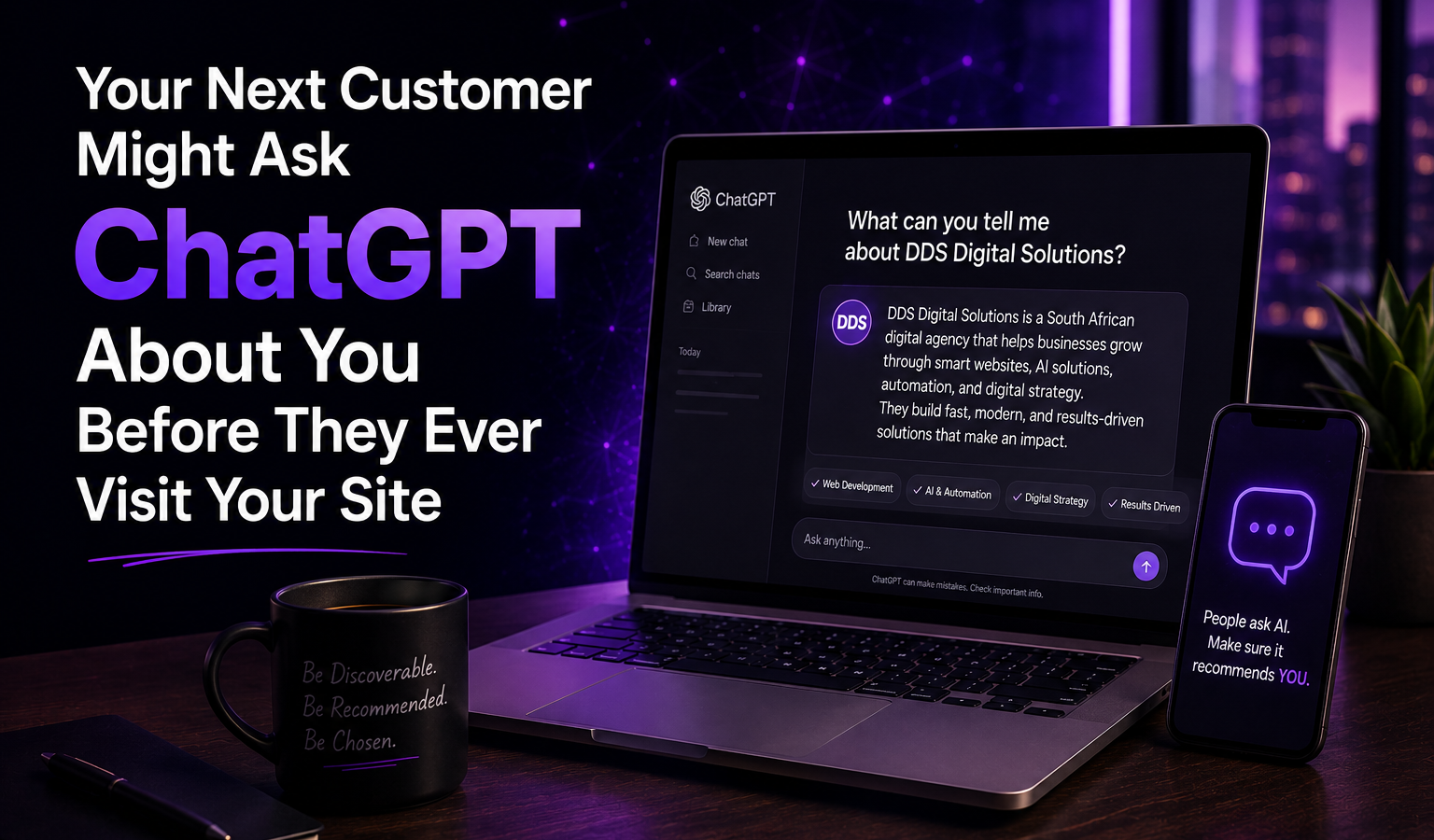
Here’s the question worth sitting with: when was the last time you typed a question into Google instead of just asking ChatGPT or Claude directly? If you’re doing it less than you used to, so is everyone else. That shift is real, it’s accelerating, and it changes what “having a good website” actually means.
The uncomfortable shift
It’s not quite true that nobody visits websites anymore, people still click through, still browse, still compare. But a growing share of research now happens entirely inside an AI conversation, with the model synthesising an answer from multiple sources and often never sending the person to a single website at all. Even inside Google, AI Overviews increasingly answer the question before a single blue link appears. The traditional search funnel most businesses built their online presence around is genuinely fracturing.
Ranking #1 on Google doesn’t mean what it used to
Traditional SEO earns you a ranking position for a human to click. What AI models do is different: they retrieve content, break it into pieces, and decide which pieces are worth quoting or citing in the answer they generate. You can rank well on Google and still be completely invisible inside a ChatGPT or Claude response, because being findable and being citable are no longer quite the same skill.
The first thing most businesses get wrong without realising it
Many websites accidentally block the very crawlers that would let AI tools read and cite them, usually thanks to a blanket bot-blocking rule a security plugin added years ago, long before anyone was thinking about this. It’s worth checking your robots.txt file specifically for GPTBot, OAI-SearchBot, ClaudeBot, and PerplexityBot, alongside the standard Googlebot and Bingbot. If any of these are blocked, you’re actively keeping AI systems from ever citing you, regardless of how good your content is.
Why Bing suddenly matters again
Most businesses set up Google Search Console years ago and never thought about Bing again. But ChatGPT’s browsing-enabled answers lean heavily on Bing’s index, not Google’s. If your site isn’t properly indexed there, you can be fully optimised everywhere else and still miss a meaningful chunk of AI-driven visibility.
Write for the question, not the keyword
AI models are good at matching a user’s actual question against a clear, direct answer sitting near the top of a section. That rewards a specific kind of writing: headings phrased the way a real person would ask the question, direct answers stated plainly rather than buried in a long lead-up, and information broken into lists or short structured chunks rather than dense paragraphs. It’s a genuinely different discipline from writing for a human scanning a page top to bottom, and most existing business websites weren’t built with it in mind.
How to actually check if you’re already invisible
The simplest test costs nothing: open ChatGPT, Claude, and Perplexity, and ask the exact questions a potential customer would ask about your industry or your business. See whether you show up, how accurately, and how often. That single exercise tells you more about your real AI visibility than any traditional ranking report will.
Where DDS fits in
This is becoming as core to a website build as traditional SEO used to be, structuring content, technical accessibility, and visibility so a business shows up whether someone’s searching or asking. Our services page covers how we build this in from the start rather than bolting it on later.
The bottom line
People haven’t stopped visiting websites entirely, but a growing share of them are arriving by way of an AI’s answer rather than a search click. The businesses that adapt to being citable, not just rankable, are the ones that stay visible either way.