
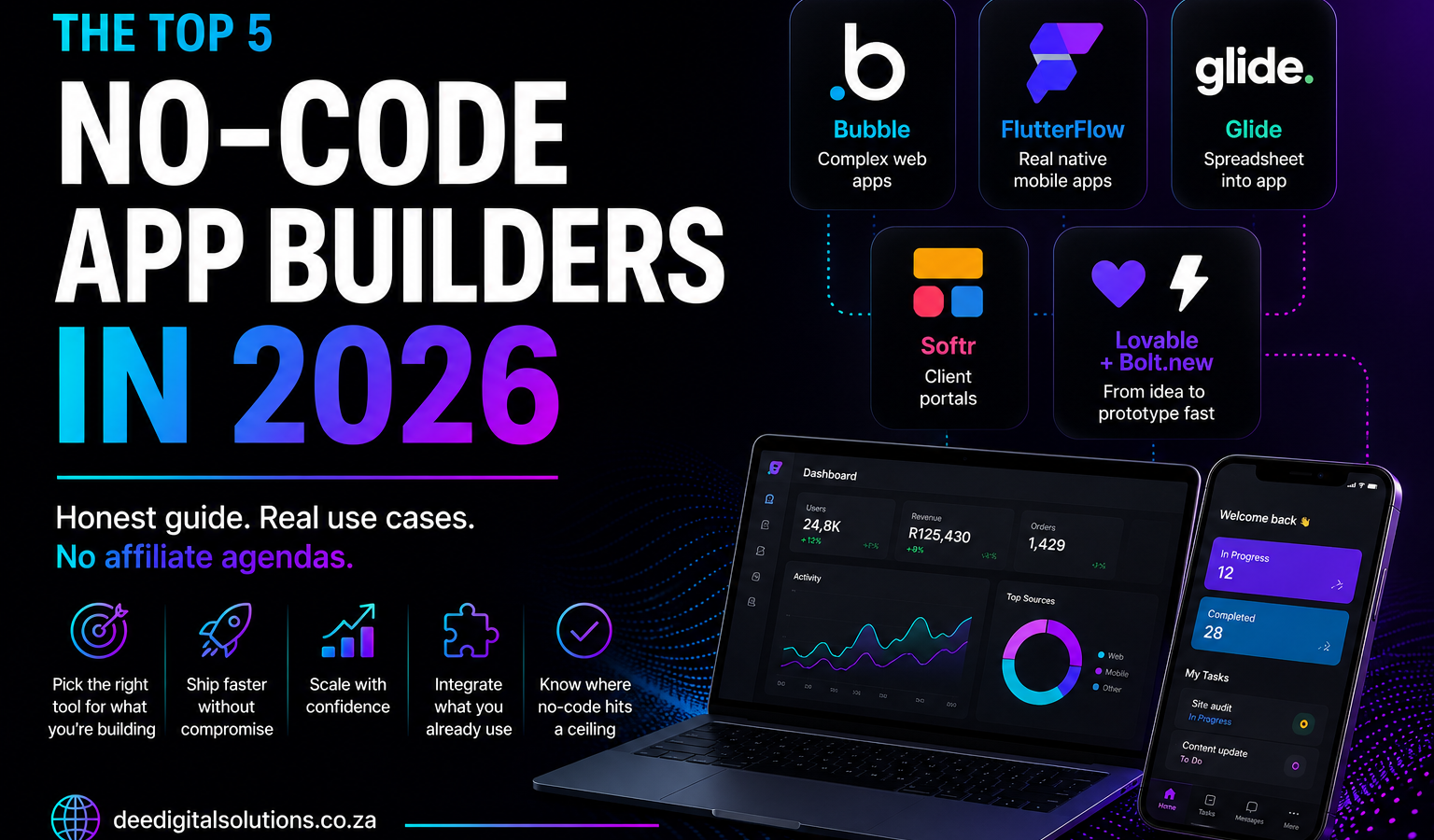
Every “best no-code app builder” list ranks the same handful of tools in a slightly different order, and most of them are sorted by who pays the highest affiliate commission. Not especially useful when you’re the one who has to live with the choice. So here’s a different approach: five genuinely different tools, what each one is actually built for, and the honest bit about where no-code stops being the right answer.
Ask this before you look at a single tool
What are you building, and where does it need to live? That one question eliminates most of the list before you’ve compared a single feature. A tool built for internal spreadsheets will buckle under a consumer app. A mobile-first platform won’t help you ship a web dashboard. Picking the wrong one doesn’t just slow you down, it boxes you in after you’ve already built half the thing.
1. Bubble, for complex web apps
Bubble is the most powerful option here and the steepest learning curve. If you’re building something with real logic behind it, user accounts, permissions, workflows that branch, it can genuinely handle it, backend included. The catch worth knowing upfront: Bubble’s pricing is usage-based, so your costs climb as your app gets busier. That’s fine when you’re small and a genuine budgeting question once you’re not.
2. FlutterFlow, for real native mobile apps
If you actually need an app in the App Store and Play Store, not a website that looks app-ish on a phone, FlutterFlow is the strongest pick. It builds on Flutter and lets you export real code, which matters more than it sounds: it means you’re not permanently locked in if the project outgrows the platform. Pricing is per seat rather than per user, so costs stay predictable as you grow.
3. Glide, for turning a spreadsheet into a tool
Glide is the fastest way to get from nothing to something people can actually use. If your business already runs on a spreadsheet, and a lot do, Glide turns it into a usable app in an afternoon. It’s built for internal tools: stock checks, job sheets, team directories, the things currently living in a shared sheet that nobody enjoys opening on their phone.
4. Softr, for client portals
Softr does one job well: a clean front end on top of data you already keep somewhere else, usually Airtable. Client portals, member areas, dashboards for people outside your business. Worth knowing before you commit: it doesn’t include its own database, so you need one already set up elsewhere. That’s a strength if you have one and a hurdle if you don’t.
5. Lovable and Bolt.new, for going from idea to prototype fast
These are a genuinely different category, sometimes called vibe coding. You describe what you want in plain language and get a working prototype back, sometimes within minutes. For testing an idea before spending real money, that speed is hard to beat. The honest catch: they generate actual code, which means someone eventually needs to maintain that code. It’s the fastest way to a demo and not the same thing as a finished product.
The part most lists skip
No-code is genuinely brilliant right up to the point where it isn’t, and it’s worth knowing where that line sits before you cross it. Platform costs that were trivial at 100 users can get uncomfortable at 10,000. Complex integrations with systems that don’t have a ready-made connector become genuinely painful. And “we need one specific thing the platform doesn’t do” has a habit of arriving right when the app has become important to your business.
None of that means don’t use these tools. It means know which category you’re in. Building an internal stock tracker? No-code, all day. Building the thing your business’s revenue depends on, that needs to scale and integrate with your existing systems? That’s a different conversation.
Where DDS fits in
A lot of our best client work starts exactly here, someone built something in Glide or Bubble, it worked, it grew, and now it needs to do things the platform can’t. Prototyping with no-code and building properly for production aren’t opposites, they’re two stages of the same project. Our services page covers where we usually pick things up.
The bottom line
Start from what you’re building, not from a ranked list. Bubble for complex web apps, FlutterFlow for native mobile, Glide for spreadsheet-based internal tools, Softr for client portals, Lovable or Bolt for a fast prototype. Pick the one that matches the job, and know in advance where its ceiling sits.